
The History of Yoga Nidra: Ancient Roots and Modern Science


There is a curious moment that some of us experience just before falling asleep.
The body becomes increasingly still. Sounds may seem distant. Thoughts begin losing their familiar structure, occasionally becoming fragmented images or dreamlike associations.
Yet somewhere within this transition, there may still be an awareness that we have not quite fallen asleep.
Neither fully engaged with the waking world nor entirely unconscious. This threshold has attracted the attention of contemplative traditions and, more recently, researchers studying sleep and consciousness.
It also raises one of the most interesting questions in yoga education: what happens when the body approaches sleep while some degree of awareness remains?
The History of Yoga Nidra provides several ways of exploring this question. Traditionally, yoganidrā has appeared in Sanskrit literature in theological, philosophical and contemplative contexts. In the twentieth century, it also became associated with structured guided practices involving body awareness, breath, imagery and intention.
Contemporary neuroscience has begun investigating what happens during these practices. But we must be careful. The modern guided method is not identical to every historical use of the word, and the physiological state experienced during a session cannot automatically be described as deep sleep, meditation or a unique state of consciousness. Understanding Yoga Nidrā requires us to examine its history and science without confusing one with the other.
What Is Yoga Nidra? Understanding Conscious Rest
The Sanskrit word nidrā means sleep. The compound yoganidrā has acquired different meanings depending upon its textual and philosophical context. Today, Yoga Nidrā generally refers to a guided contemplative practice, frequently undertaken in Śavāsana or another supported position.
A contemporary session may include progressive body awareness, rotation of consciousness, breath observation, sensory awareness, imagery, intention and a gradual return to ordinary waking attention. The practitioner is generally encouraged to remain aware without excessive effort.
However, this does not mean that everybody will remain awake. Someone may experience vivid imagery. Another may feel relaxed but alert. Someone else may drift into ordinary sleep.
The experience varies. Yoga Nidrā is not defined by successfully producing one predetermined sensation or brainwave pattern. That variability becomes important when we examine both its historical origins and contemporary research.
The History of Yoga Nidra in Ancient Sanskrit Literature
The term yoganidrā did not originate as the name of a twenty-minute guided relaxation recording. Sanskrit scholar Jason Birch and researcher Jacqueline Hargreaves have traced its diverse meanings across epic, Purāṇic, Tantric and medieval yogic literature. Their historical work is particularly useful because it challenges the assumption that the modern guided method has existed unchanged for thousands of years.
Viṣṇu and Cosmic Sleep in the Mahābhārata
An early occurrence appears in the Mahābhārata, where yoganidrā is associated with Viṣṇu's extraordinary sleep between cosmic cycles. This is not an instruction for performing a body scan. It belongs to a theological account of cosmic existence. The symbolism of divine sleep is profoundly different from the physiological process of an ordinary person becoming drowsy.
Yoganidrā as Goddess in the Devī Māhātmya
Within the Devī Māhātmya, part of the Mārkaṇḍeya Purāṇa, Yoganidrā appears as a manifestation of the Goddess. In the narrative involving Madhu and Kaiṭabha, Brahmā invokes the Goddess so that Viṣṇu may awaken.
This is particularly significant when considering the wider Śākta philosophical context. Here, Yoganidrā is not merely a technique for reducing stress. She belongs to a theological understanding of divine power, cosmic activity and the relationship between consciousness and manifestation.
This is one reason I believe traditional literature must be studied on its own terms rather than translated immediately into modern physiological explanations.
The Vijñāna Bhairava and the Threshold of Sleep
The Vijñāna Bhairava Tantra, associated with the non-dual Śaiva traditions of Kashmir, contains a contemplation especially relevant to the transition between sleeping and waking.
Verse 75 begins: anāgatāyāṃ nidrāyāṃ praṇaṣṭe bāhyagocare
The verse directs attention towards the state in which external sensory awareness has diminished but sleep has not yet fully arrived. Within its traditional philosophical setting, this threshold becomes an opportunity for contemplative recognition.
The teaching is not a twentieth-century Yoga Nidrā script. Nevertheless, it demonstrates that the liminal condition preceding sleep was recognised as a meaningful subject of spiritual enquiry.
Yoganidrā in the Yogatārāvalī and Haṭhapradīpikā
The term also appears in medieval yoga texts, including the Yogatārāvalī and the Haṭhapradīpikā. In these contexts, yoganidrā can refer to advanced meditative absorption rather than guided relaxation.
The Yogatārāvalī is traditionally attributed to Śaṅkarācārya, although its historical dating and authorship should not be treated as conclusively established.
The Haṭhapradīpikā associates yoganidrā with the broader pursuit of samādhi. These references are important because they demonstrate that the word has a substantial contemplative history.
But they do not establish that modern guided Yoga Nidrā is an unchanged technique transmitted directly from those texts.
Historical continuity of a term does not necessarily establish continuity of an identical practice.
The Modern Development of Yoga Nidra
The modern guided form became widely known through Swami Satyananda Saraswati and the Bihar School of Yoga during the twentieth century. His book Yoga Nidra, first published in 1976, presented a structured method drawing upon earlier yogic and Tantric ideas alongside approaches suited to contemporary practitioners.
The method incorporated stages such as saṅkalpa, rotation of consciousness, breath awareness, contrasting sensations and visualisation. Satyananda connected rotation of consciousness with nyāsa, a family of Tantric practices involving the ritual placing or installation of mantras and divine associations upon the body.
However, historical scholarship cautions against treating modern body scanning as identical to traditional nyāsa. The contemporary format has undergone adaptations through different teachers and schools, including approaches incorporating therapeutic language and psychological enquiry.
There is therefore no single universal Yoga Nidrā script, and not every approach shares exactly the same philosophical assumptions. A well-educated facilitator should understand this history rather than presenting one contemporary sequence as the sole authentic method.
Yoga Nidra, the Brain and the Science of Sleep
The nervous system is central to understanding the experience of sleep and wakefulness. Wakefulness and sleep involve interactions between multiple brain systems, including networks associated with attention, arousal, sensory processing and sleep regulation.
The transition is not always instantaneous. A person may gradually become less responsive to external stimuli while retaining intermittent awareness. Electroencephalography, or EEG, records electrical activity detectable at the scalp.
Researchers examine patterns of oscillatory activity across different frequencies. These frequencies are commonly grouped into delta, theta, alpha and beta bands, although the meaning of each pattern depends on brain region, behavioural context and recording conditions.
Beta Activity: Ordinary Waking Engagement
Beta activity, often described around 13-30 Hz, is associated with several waking processes, including aspects of alertness and sensorimotor activity. It is misleading to describe beta as simply the frequency of stress. An attentive person can display beta activity without experiencing anxiety.
Alpha Activity: Relaxed Wakefulness
Alpha activity, commonly around 8-13 Hz, is often prominent during relaxed wakefulness with closed eyes. As a person approaches sleep, the organisation of alpha activity may change. However, increased alpha activity does not establish that someone has entered Yoga Nidrā or achieved an advanced meditative state.
Theta Activity: Drowsiness and Changing Awareness
Theta activity, often around 4-8 Hz, can become relevant during drowsiness and the early transition towards sleep. Yet theta activity also appears in other contexts.
It is not exclusively a marker of meditation, imagination or subconscious programming.
Delta Activity: Slow Waves and Sleep
Delta activity occupies the slower frequency range, commonly around 0.5-4 Hz.
Prominent slow-wave activity is associated with deep non-REM sleep. However, the presence of delta power in a particular brain region does not necessarily mean the entire brain has entered deep sleep. This becomes especially important when discussing Yoga Nidrā.
Brainwave frequency bands are measurements of electrical activity, not simple labels for consciousness, emotional healing or spiritual attainment.
Is Yoga Nidra Really a Half-Asleep, Half-Awake State?
The expression half asleep, half awake is familiar to many Yoga Nidrā practitioners. It describes a subjective experience that may resemble the transition towards sleep. In sleep science, this transitional period is often discussed through the concept of hypnagogia.
Hypnagogic experiences may involve fragmented imagery, altered sensory perception, unusual associations and changing awareness of the surrounding environment. However, hypnagogia is not itself proof of Yoga Nidrā, nor does every Yoga Nidrā session produce hypnagogia.
What the EEG Research Found
A 2022 study investigated Yoga Nidrā using polysomnography, a recording approach incorporating EEG and other physiological measures. Thirty participants completed introductory practice, and electrophysiological analysis was subsequently undertaken. The researchers reported that most analysed sessions remained classified as wakefulness. However, they also observed changes in slow-wave power within particular regions.
The authors discussed this as evidence compatible with aspects of local sleep. This finding is fascinating because it suggests that some slow-wave activity may occur regionally while the overall recording remains classified as wakefulness.
But it does not demonstrate that every Yoga Nidrā practitioner occupies a universal state halfway between sleeping and waking. Nor does it establish that the same changes occur in experienced meditators and beginners.
What Does Functional MRI Add?
A 2024 functional MRI investigation compared 30 experienced meditators or yogic practitioners with 31 novices. Researchers reported differences in functional connectivity during Yoga Nidrā, including patterns involving the default mode network.
The default mode network is associated with several processes, including internally directed cognition. But a change in functional connectivity is not equivalent to demonstrating a particular spiritual state.
The results suggest that experience and practice history may influence the neural correlates of Yoga Nidrā. They do not justify a universal claim that the practice switches off the thinking mind.
Yoga Nidra and the Autonomic Nervous System
Yoga Nidrā is frequently described as a technique for activating the parasympathetic nervous system. This explanation is incomplete.
The autonomic nervous system contributes to cardiovascular activity, digestion and many other functions. Sympathetic and parasympathetic influences are not simply opposing switches, one representing stress and the other relaxation. They participate in dynamic regulation.
A supported position, reduced physical demand and gentle guidance may influence the conditions in which rest is experienced. But a person's subjective relaxation does not independently establish their autonomic state. To investigate physiological responses, researchers may measure heart rate, heart-rate variability, breathing patterns or other variables.
Each measure has interpretative limitations. For instance, heart-rate variability is influenced by breathing and several other physiological and contextual factors. It should not be treated as a direct measurement of spiritual progress or total nervous-system health. Yoga Nidrā may provide an opportunity to investigate rest and awareness.
It should not be marketed as a guaranteed nervous-system reset.
Why Are Affirmations and Saṅkalpa Used During Yoga Nidra?
One of the distinctive elements of many modern Yoga Nidrā approaches is saṅkalpa. The word has a broader Sanskrit history involving intention, resolve and determination.
Within contemporary guided Yoga Nidrā, it is often introduced as a personally meaningful resolution. Some facilitators suggest that an intention may be particularly powerful when introduced near the threshold of sleep.
This explanation is commonly associated with the idea that the conscious, critical mind becomes quieter while deeper psychological processes remain accessible. There is an interesting scientific question here, but we should distinguish the hypothesis from the evidence.
Does the Hypnagogic State Make the Mind More Suggestible?
The sleep-onset transition involves changes in attention, awareness and information processing. Research has investigated memory processing and responsiveness during different sleep and sleep-onset conditions.
However, these findings do not establish that every affirmation delivered during Yoga Nidrā becomes permanently embedded in the subconscious. Nor do they demonstrate that the mind becomes universally more receptive to positive statements. Claims that affirmations automatically reprogram beliefs, erase trauma or bypass psychological resistance are not adequately established.
What Makes Saṅkalpa Different From a Generic Affirmation?
A generic affirmation may prescribe a desired belief. Saṅkalpa, when approached thoughtfully, can represent a more personally meaningful intention shaped by the practitioner's values and circumstances.
The language should not impose an identity or outcome. A facilitator might invite the student to consider an intention without insisting upon one.
For some practitioners, remaining with simple awareness may be more appropriate than introducing emotionally significant statements. This distinction becomes especially important when teachers facilitate Yoga Nidrā in mixed groups.
An intention should support personal agency, not become a vehicle for the teacher's psychological suggestions.
Why Yoga Nidra Is Often Combined With Sound Baths
Yoga Nidrā and sound baths are frequently offered together because their practical conditions overlap. Both commonly involve supported reclining positions, reduced physical activity and sustained attention to auditory experience.
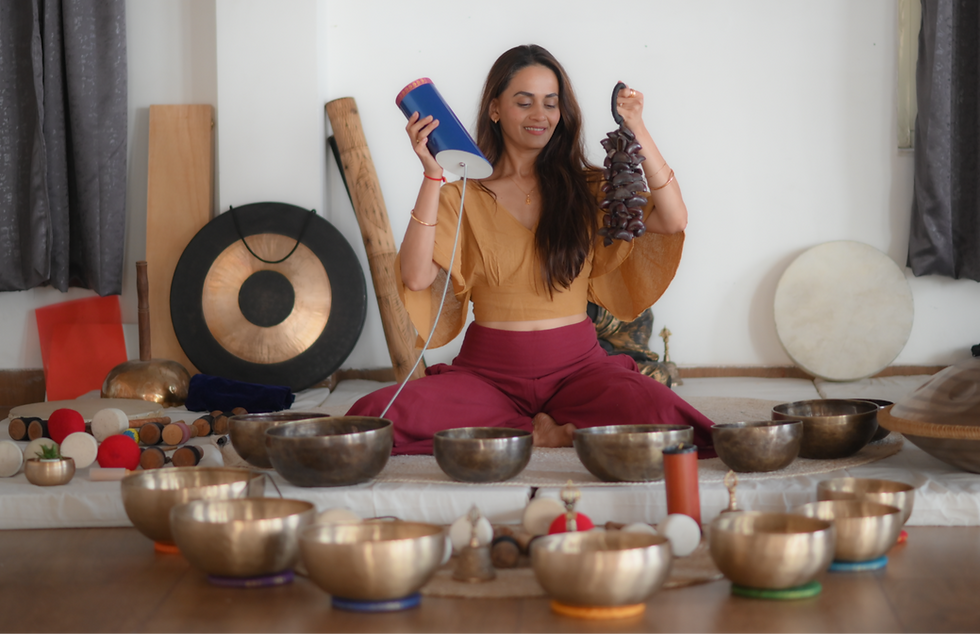
Sounds from instruments such as singing bowls, gongs and chimes can create an evolving sensory environment. During guided rest, sound may provide an attentional anchor or contribute to the atmosphere of the session.
Some practitioners report that the combination feels immersive. Others may find particular sounds distracting, uncomfortable or emotionally evocative. The effects are not universal.
Does Sound Change Brainwaves?
Auditory stimulation can influence brain activity. But it does not follow that a singing bowl automatically produces theta activity or that a gong places everyone into deep sleep.
The relationship between auditory stimulation and neural activity depends upon the sound, the person, the task and the method of measurement. A 2025 systematic review of Tibetan singing-bowl interventions identified promising findings for selected psychological and physiological outcomes, but the available studies varied considerably in quality and intervention design.
This does not establish that combining sound baths with Yoga Nidrā produces superior results to either practice alone. Comparative research would be needed to make that claim.
Why Timing and Silence Matter
For a Yoga Nidrā facilitator, sound should not automatically fill every moment. A sudden gong strike may interrupt a person's experience rather than deepen it. Continuous sound may also compete with spoken guidance.
A thoughtful session considers the relationship between voice, silence, volume, instrument choice and individual tolerance. This is why teaching Yoga Nidrā alongside sound healing requires more than choosing relaxing instruments. The facilitator must understand what each component contributes and when it may be appropriate to use it.
Why Yoga Therapists and Facilitators Must Be Careful With Suggestion
The relationship between guided awareness and psychological suggestion deserves particular attention. A person lying quietly with closed eyes may appear deeply relaxed. But the teacher cannot assume that the individual feels safe, comfortable or receptive.
Neither should a facilitator interpret unexpected emotional responses as proof that trauma is being released. Yoga therapists may integrate Yoga Nidrā within a broader professional framework, subject to their training and scope of practice. However, Yoga Nidrā certification alone does not confer qualification to provide psychotherapy or clinical treatment.
Suggestions should avoid promises about curing anxiety, changing traumatic memories or permanently transforming the subconscious. Students should be free to decline imagery, omit a saṅkalpa, keep their eyes open or change position. This is not an incidental teaching consideration. It is central to responsible facilitation.
Yoga Nidra in Restorative Yoga and Yin Yoga Classes
Yoga Nidrā can complement both Restorative Yoga and Yin Yoga, but the context changes how it should be introduced.
Yoga Nidrā and Restorative Yoga
Restorative Yoga emphasises support and the reduction of unnecessary physical demand. Yoga Nidrā may complement these conditions through guided awareness, breathing observation and sensory attention. A practitioner might begin with a supported restorative position before entering a shorter Yoga Nidrā practice.
However, the teacher should distinguish the physical positioning from the guided contemplative method. Restorative Yoga is not automatically Yoga Nidrā simply because someone lies down and becomes quiet.
Yoga Nidrā and Yin Yoga
Yin Yoga commonly involves sustained mechanical loading and the observation of sensation. Yoga Nidrā can be introduced after the physically demanding portion of the practice, particularly during the final supported rest. Elements of attentional guidance may also inform Yin teaching.
But a prolonged Yin posture with significant stretching sensations may not be the most appropriate context for a full Yoga Nidrā sequence. The student's physical demands remain relevant. A contemplative practice should not become a reason to ignore discomfort or remain in a mechanically inappropriate position.
The Somāntra™ Approach to Yoga Nidra: From Guided Rest to Discernment
At The Yoga Nerds, the Somāntra™ Approach places Yoga Nidrā within a wider study of sensation, attention, psychology and Indian yogic philosophy.
It recognises that the experience of conscious rest cannot be reduced to a single brainwave pattern. Nor should a guided session be treated as a guaranteed method of psychological transformation. The eight Somāntra™ principles offer a structured form of enquiry.
Sensation begins with noticing what is experienced without prematurely assigning meaning.
Orientation recognises the body, surrounding environment and conditions of support.
Movement includes the possibility of adjustment, stillness and choosing a different position.
Ānchoring concerns the direction of attention towards breath, physical contact, sound or another appropriate reference.
Navigation encourages thoughtful responses to changing experience.
Trust develops through recognising personal preferences and boundaries rather than unquestioningly following instructions.
Reflection allows the practitioner to examine assumptions about rest, attention and performance.
Assimilation considers what, if anything, becomes meaningful beyond the immediate session.
These principles are not eight validated neurological stages. They provide an educational framework for facilitating Yoga Nidrā with greater awareness and individual choice.
Pratyāhāra and the Wider Yogic Path
Within Patañjali's aṣṭāṅga framework, pratyāhāra is commonly understood in relation to the withdrawal or reorientation of the senses. Yoga Nidrā may be taught in conversation with this concept.
However, the modern guided method should not be presented as identical to every classical description of pratyāhāra. Its value within Somāntra™ lies partly in exploring how external attention may become less dominant while awareness remains present.
This can provide a foundation for deeper contemplative enquiry without promising samādhi or spiritual liberation.
Why Yoga Teachers Should Study Yoga Nidra Properly
A competent Yoga Nidrā teacher should understand more than the words of a script. The skill involves knowing why a particular sequence is used, how it relates to traditional practice, what scientific research does and does not establish, and how different people may respond.
Voice, pacing, silence, language and the arrangement of physical support are all important. So are consent, professional boundaries and the ability to modify a session.
A teacher should understand the difference between a saṅkalpa and an imposed affirmation. They should know why a student falling asleep is not necessarily a failure.
And they should avoid claiming that a practitioner has entered a particular brainwave state based only on appearance. These are some of the reasons advanced Yoga Nidrā education matters.
Study the 25-Hour Yoga Nidra Teacher Training Online
The Yoga Nerds offers a 25-Hour Online Yoga Nidra Teacher Training for practitioners and teachers wishing to understand, practise and facilitate Yoga Nidrā with greater depth.
The course explores the history and philosophical foundations of Yoga Nidrā alongside contemporary understanding of sleep, attention, stress physiology and conscious rest.
Students examine the structure of guided practices, saṅkalpa, body awareness, breathing, visualisation, the use of voice, adaptation and responsible facilitation. The emphasis is not simply on memorising a script.
It is on understanding the purpose of the guidance and developing the judgement to use it appropriately.
Progress to the 300-Hour Somāntra™ Yoga Teacher Training
The 300-Hour Somāntra™ Yoga Teacher Training integrates Yoga Nidrā within its wider advanced pathway.
The Nervous System Sovereignty component combines 50 hours of Restorative Yoga, 25 hours of Yoga Nidrā and 25 hours of Meditation. Together, these disciplines explore different relationships between physical rest, attention, perception and contemplative enquiry.
The broader programme also includes Yin Yoga, Prāṇāyāma, Myofascial Exercise, subtle-body literacy and Daśa Mahāvidyā studies.
Practical learning opportunities are available in Scotland, near Edinburgh, alongside online study.
The objective is to develop educators who understand not merely how to guide a practice, but why particular methods are chosen, how they may be experienced and where the limits of their knowledge lie.
Five Frequently Asked Questions About the History of Yoga Nidra
Is Yoga Nidra an Ancient Practice?
The term yoganidrā appears in ancient and medieval Sanskrit literature, but its meanings vary. The familiar structured guided relaxation method was developed and popularised in the twentieth century.
Is Yoga Nidra the Same as Being Half Asleep?
Some practitioners experience a state resembling the sleep-onset transition, but research has also recorded Yoga Nidrā sessions classified as wakefulness. There is no single universally established brainwave signature.
Does Yoga Nidra Produce Theta or Delta Brainwaves?
Studies have identified changes in EEG activity, including regional slow-wave power. However, these findings do not demonstrate that every session produces a specific frequency pattern or state of consciousness.
Why Are Affirmations Used During Yoga Nidra?
Many modern methods use saṅkalpa as a personally meaningful resolve. Claims that affirmations delivered during Yoga Nidrā automatically reprogram the subconscious remain insufficiently demonstrated.
Can Yoga Nidra Be Combined With Sound Healing and Restorative Yoga?
Yes. These practices can complement one another when their different purposes are understood. However, combining them does not automatically establish superior physiological or therapeutic outcomes.
Conclusion: Why the History of Yoga Nidra Matters to Modern Yoga Teachers
The History of Yoga Nidra reveals a fascinating relationship between traditional contemplative philosophy, modern guided practice and contemporary neuroscience. Sanskrit literature describes divine sleep, advanced meditation and the threshold between waking and sleeping.
Twentieth-century teachers developed structured guided methods that have become accessible to contemporary practitioners. Modern research has begun investigating changes in sleep-related physiology, neural activity and psychological outcomes.
Yet significant questions remain. We do not possess a single definitive brainwave signature of Yoga Nidrā. We cannot guarantee that a practitioner will remain half asleep and half awake. Nor can we claim that every saṅkalpa delivered during this state will permanently transform the subconscious mind.
These limitations do not make Yoga Nidrā less meaningful. They make responsible education more important.
At The Yoga Nerds, the Somāntra™ Approach brings scientific literacy into conversation with Indian yogic philosophy, attention, embodied experience and thoughtful facilitation.
Explore our 25-Hour Online Yoga Nidra Teacher Training or continue into the 300-Hour Somāntra™ Advanced Yoga Teacher Training near Edinburgh, Scotland and online.
Because teaching Yoga Nidrā is not simply the art of helping somebody fall asleep. It is the responsibility of understanding how guidance, awareness, experience and the boundaries of our knowledge intersect.
Research and Historical References
Birch, J., & Hargreaves, J. (2015). Yoganidrā: An Understanding of the History and Context. https://www.theluminescent.org/2015/01/yoganidra.html
Parker, S., Bharati, S. V., & Fernandez, M. (2013). Defining yoga-nidra: Traditional accounts, physiological research, and future directions. International Journal of Yoga Therapy, 23(1), 11–16. https://pubmed.ncbi.nlm.nih.gov/24016819/
The Origin and Clinical Relevance of Yoga Nidra (2022). https://pmc.ncbi.nlm.nih.gov/articles/PMC9033521/
Electrophysiological Evidence of Local Sleep During Yoga Nidra Practice (2022). https://pmc.ncbi.nlm.nih.gov/articles/PMC9315270/
Functional Connectivity Changes in Meditators and Novices During Yoga Nidra Practice (2024). https://pmc.ncbi.nlm.nih.gov/articles/PMC11153538/
Effects of Yoga Nidra on Stress, Anxiety, and Depression: A Systematic Review and Meta-Analysis (2026). https://pmc.ncbi.nlm.nih.gov/articles/PMC12917937/
The Hypnagogic State: A Brief Update (2023). https://pmc.ncbi.nlm.nih.gov/articles/PMC10078162/
Effects of Tibetan Singing Bowl Intervention on Psychological and Physiological Health in Adults: A Systematic Review (2025). https://pmc.ncbi.nlm.nih.gov/articles/PMC12385955/
Vijñāna Bhairava Tantra, verse 75, considered within its Śaiva philosophical context.
Devī Māhātmya, first chapter, for the theological significance of Yoganidrā.
Haṭhapradīpikā, chapter 4, for medieval uses of yoganidrā in relation to advanced contemplative states.
Madhura Bhagwat is the founder of The Yoga Nerds and creator of the Somāntra™ Approach. Drawing upon more than two decades of yoga teaching experience, her educational work integrates Indian yogic philosophy, anatomy, physiology, contemplative enquiry and research literacy to encourage thoughtful, responsible yoga teaching.


Comments