
300-Hour Yoga Teacher Training: How to Choose an Advanced Course


You've completed your foundational yoga teacher training. You understand basic anatomy, can construct a sequence, explain the principles of āsana and guide students through a class. Perhaps you've even taught for several years.
So, what comes next?
For many teachers, the obvious answer appears to be a 300-hour yoga teacher training. Another qualification, more advanced postures, more techniques, perhaps a few additional certificates to display on the studio wall. But consider a more interesting question.
What exactly makes yoga education advanced? Is it performing increasingly difficult āsanas? Learning a larger collection of breathing techniques? Becoming familiar with scientific terminology? Or developing the ability to understand, question and adapt what we teach?
I would argue that advanced yoga education should involve the last of these. A meaningful 300-hour course should deepen our understanding of the human body, challenge our assumptions, develop philosophical literacy and improve our capacity to make responsible teaching decisions.
At The Yoga Nerds, this is the foundation of the Somāntra™ Approach: an advanced pathway integrating anatomy, physiology, embodied observation, Indian yogic philosophy, contemplative practices and the art of facilitation. But before choosing any advanced course, there are several important considerations.
What Is a 300-Hour Yoga Teacher Training?
A 300-hour yoga teacher training is an advanced programme designed to build upon the foundational knowledge and teaching skills typically developed through a 200-hour course. It should not simply repeat introductory education with additional material.
According to Yoga Alliance's RYS 300 standards, an advanced programme should deepen the teacher's understanding across practice, teaching methodology, anatomy and physiology, yoga philosophy, professional ethics and practicum.
The purpose is to enable teachers to work with greater sophistication than would ordinarily be expected following foundational training. Importantly, this does not mean that every 300-hour programme teaches the same content.
One school might emphasise advanced āsana, another meditation and philosophy, while another focuses on functional anatomy, restorative practices or specialised teaching. This makes curriculum evaluation particularly important.
The number of training hours tells you how much education is being offered. It does not independently establish the quality, depth or relevance of that education.
How to Choose a 300-Hour Yoga Teacher Training That Is Genuinely Advanced
Before enrolling, investigate what the programme expects you to understand and demonstrate.
1. Does It Develop Critical Thinking or Simply Teach More Techniques?
There is a difference between knowing how to teach a posture and understanding why you might choose it. Imagine a student who cannot comfortably enter Padmāsana. A teacher might recommend additional hip-opening exercises, assuming insufficient flexibility.
But what if the limitation involves the geometry of the hip joint, the available range of rotation or the relationship between the femur and acetabulum?
Repeated stretching cannot change every relevant anatomical constraint.
An advanced teacher should be able to consider several possibilities without immediately prescribing a solution. This requires anatomical knowledge, observation, appropriate questioning and an understanding of professional limitations. A good training programme encourages that reasoning. A weaker programme simply provides another collection of instructions to memorise.
2. Does the Anatomy Go Beyond Naming Muscles?
Knowing the names of muscles is useful. Understanding how movement actually occurs is considerably more important. For example, hip flexion involves interactions between joint morphology, muscle activity, soft-tissue properties, pelvic positioning and the demands of a particular movement.
Two people may perform visually similar forward folds while experiencing very different mechanical demands. The available movement is influenced by individual skeletal anatomy, neuromuscular control, tissue properties and previous experience.
An advanced teacher should also distinguish tension from compression.
Tension refers to tensile loading or resistance within tissues. Compression occurs when structures are pressed together, including possible contact between bony surfaces. Neither can always be identified with certainty from appearance alone.
A teacher who assumes every restriction is muscular tightness may continue encouraging range of motion where additional stretching is inappropriate.
This is why advanced anatomy should explore movement mechanics, joint structure, loading, adaptation and uncertainty, not merely anatomical vocabulary.
3. Does It Teach Scientific Literacy?
Science-informed yoga education has become popular. Unfortunately, scientific terminology is sometimes used more enthusiastically than scientific reasoning. Consider claims that particular movements release stored trauma from fascia, that spinal twists flush toxins or that every restorative posture resets the nervous system.
These statements may sound convincing, particularly when accompanied by complex terminology. But what evidence supports them? Does a study demonstrate the proposed mechanism? Were outcomes measured? What population was studied? Can the findings be applied to ordinary yoga classes?
A scientifically literate teacher should distinguish between established knowledge, emerging hypotheses, traditional explanations and marketing language.
Being able to repeat a scientific explanation is not the same as being able to evaluate one.
Why Advanced Yoga Teacher Training Must Include Educational Science
One frequently overlooked consideration is how teachers actually learn. Access to information does not automatically create competence.
A beautifully presented online course might contain hundreds of hours of lectures, but watching them does not establish that a student can apply the material. Research into active learning provides useful insights.
A 2014 meta-analysis by Freeman and colleagues examined 225 studies in undergraduate science, technology, engineering and mathematics education.
The researchers found that active-learning approaches improved examination performance compared with traditional lecturing.
Although these findings cannot simply be transferred unchanged to yoga teacher education, they support a broader educational principle: learners benefit from opportunities to actively engage with and apply what they study.
For yoga teachers, this might involve explaining why a posture is modified, analysing different teaching scenarios, developing lesson plans, completing reflective assignments and receiving feedback.
Why Feedback Matters
Imagine teaching a sequence and receiving the comment, "That was lovely."
Encouraging? Certainly. Educationally useful? Not necessarily.
What was effective about the sequencing? Were the instructions clear? Did the transitions create unnecessary demands? Were appropriate alternatives available? Specific feedback provides information that can inform the next teaching attempt.
This is why an advanced course should include meaningful assessment rather than awarding certification solely because a student has watched the required content.
Online 300-Hour Yoga Teacher Training Versus In-Person Learning
An Online 300-hour yoga teacher training can provide access to specialist education regardless of geographical location. It can also allow students to revisit complex material, study alongside existing employment and spend time reflecting on concepts.
However, flexibility should not mean the absence of educational structure. A programme that provides unlimited recorded content without meaningful participation, deadlines or feedback risks confusing access with learning.
Equally, an in-person intensive is not automatically superior simply because everyone shares a physical space. A teacher can attend hours of demonstrations without meaningfully developing their own understanding.
The strongest question is not whether a course is delivered online or in person. It is whether its design supports active learning, practice, reflection, application and assessment.
For online learning, investigate the opportunities for interaction and feedback. For in-person learning, examine practical teaching time, student numbers and the quality of instruction. Neither format guarantees educational depth.
Why Yoga Philosophy Must Remain Central to Advanced Training
Yoga is not merely a movement system awaiting validation through modern neuroscience. It emerges from diverse Indian philosophical, contemplative and practical traditions that have developed across different historical periods. A serious advanced course should engage with these traditions in their own intellectual context.
Consider Patañjali's Yoga Sūtra 2.46, sthira-sukham āsanam, commonly interpreted in relation to steadiness and ease in posture.
The following sūtra, 2.47, refers to prayatna-śaithilya, the easing or relaxation of effort, alongside ananta-samāpatti, a term subject to different traditional interpretations.
These passages invite investigation into the relationship between effort, attention and steadiness. But they are not instructions for measuring parasympathetic activity.
Similarly, the pañca kośa teachings of the Taittirīya Upaniṣad offer a traditional framework for contemplating dimensions of human experience. The kośas should not be presented as newly discovered anatomical layers.
Respecting Indian yogic philosophy means studying its concepts seriously, not selectively translating them into fashionable scientific terminology.
A meaningful advanced training should develop the ability to read, question, contextualise and interpret philosophical material. Without this, yoga risks being reduced to physical exercise decorated with Sanskrit vocabulary.
The Somāntra™ Approach: Why Our Advanced Yoga Teacher Training Is Different
At The Yoga Nerds, Somāntra™ begins with a simple but challenging proposition:
Advanced teaching is not about knowing more techniques. It is about understanding more deeply what we already teach.
Somāntra™ is a modular advanced yoga education pathway bringing together structural understanding, nervous-system literacy, contemplative practice, subtle-body enquiry and responsible facilitation.
Rather than treating each subject as an isolated certificate, the approach asks how different dimensions of practice relate to one another.
The programme currently identifies three 100-hour components forming a 300-hour core, with an additional 50-hour Sound Healing pathway extending the curriculum to 350 hours.
This component brings together:
Students investigate stress physiology, physical support, attention, guided rest, teaching language and the limitations of popular nervous-system claims. The objective is not to promise that every student can be placed into a predetermined physiological state. It is to understand how practices may be experienced differently and how to facilitate them responsibly.
Explore our 100-Hour Nervous System Sovereignty Training or read Nervous System Yoga Teacher Training: What Does It Include? for a closer examination.
This component explores Yin Yoga, Prāṇāyāma and myofascial movement.
Through functional anatomy, students consider how joint morphology, muscular activity, connective tissues, compression and tension influence movement. A fascia model may provide one useful way of describing relationships between structures.
But a theoretical map does not establish that every student experiences loading in the same way. Similarly, breathing practices require more than repeating claims about vagal stimulation.
Teachers need to understand relevant respiratory physiology, individual tolerance and the purpose of the technique. Our 50-Hour Yin Yoga Teacher Training provides a useful example of how Somāntra™ combines physical observation with contemplative enquiry.
This component examines traditional frameworks and the responsibilities involved in facilitating more introspective practices. Areas identified within the Somāntra™ curriculum include the Daśa Mahāvidyā, chakra and kośa frameworks, Prasūti Tantra, trauma-aware teaching and facilitation.
These subjects require thoughtful contextualisation. Traditional subtle-body models are not interchangeable with anatomical descriptions, and philosophical interpretations should not be presented as established clinical mechanisms. Similarly, trauma awareness does not confer competence to diagnose or provide psychotherapy.
Mature teaching requires knowing both what a discipline offers and where its professional boundaries lie.
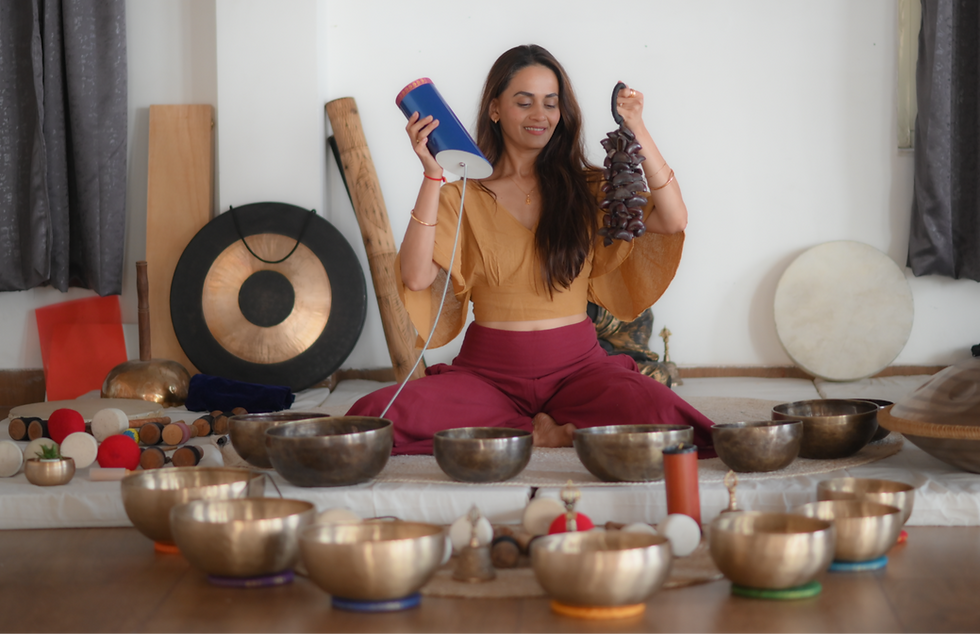
The separate 50-hour Sound Healing component extends the core Somāntra™ pathway to 350 hours. It explores sound-based practices, listening, instruments, voice and group facilitation. Here too, scientific precision matters.
The existence of sound vibration does not establish that a particular frequency heals an organ or treats a medical condition. Teachers should distinguish physical acoustics, subjective experience, traditional interpretations and experimentally demonstrated outcomes. The intention is to develop responsible facilitation rather than extraordinary therapeutic claims.
How Does a 300-Hour Course Contribute to the 500-Hour Yoga Teacher Training Pathway?
A commonly misunderstood question concerns the relationship between 200-hour, 300-hour and 500-hour yoga teacher training.
Under Yoga Alliance's standard RYT 500 route, an eligible 200-hour qualification may be combined with an eligible 300-hour advanced qualification from registered schools.
Yoga Alliance also requires at least 100 hours of teaching experience after completing an eligible foundational or integrated training programme. However, these are organisational credential requirements, not universal legal permissions to teach yoga.
Students must verify the registered status and eligibility of the specific programme they intend to complete. Accumulating unrelated workshops or continuing education certificates does not automatically establish an eligible 300-hour qualification.
Similarly, a 350-hour educational programme is not automatically equivalent to an independently registered RYS 300 qualification. If you are exploring the 500-hour yoga teacher training pathway, clarify the precise certification and registration arrangements before enrolling.
For those still developing their foundational education, our 200-Hour Multi-Style Yoga Teacher Training in Scotland provides an opportunity to establish the underlying teaching, anatomical and philosophical knowledge before pursuing advanced specialisation.
Common Mistakes When Choosing an Advanced Yoga Teacher Training
Mistaking Complex Postures for Advanced Teaching
A person may perform demanding āsanas and still struggle to explain how to adapt basic movements for someone with different anatomy. Physical ability and teaching competence overlap, but they are not equivalent.
Choosing a Course Solely for the Certificate
A qualification may be professionally useful, but the certificate itself does not demonstrate the quality of an individual's teaching decisions. Investigate how competence is assessed.
Believing That More Scientific Terminology Means Better Science
Terms such as proprioception, vagal tone, fascial hydration or autonomic regulation can be useful. They become problematic when employed without appropriate definitions, evidence or context.
Assuming Traditional Yoga and Neuroscience Describe Identical Things
Both offer valuable forms of enquiry, but their methods, concepts and objectives are not identical. Intellectual maturity requires recognising those differences.
Confusing Specialised Yoga Education With Clinical Qualifications
Advanced yoga education can deepen knowledge and facilitate more thoughtful teaching. It does not automatically qualify someone to provide physiotherapy, medical treatment, psychotherapy or other regulated healthcare services.
Who Should Consider the Somāntra™ Advanced Pathway?
Somāntra™ may particularly interest teachers who have begun to question rigid alignment rules, simplistic physiological claims or teaching methods that assume every student responds identically. It is also relevant to teachers wishing to develop specialist knowledge in Restorative Yoga, Yoga Nidrā, Meditation, Yin Yoga, Prāṇāyāma, subtle-body philosophy or group facilitation.
The pathway is not built around becoming physically more impressive. It is intended to develop teachers who can observe carefully, investigate assumptions, adapt intelligently and explain the reasoning behind their decisions. This matters whether you teach large studio classes, work with private students or facilitate workshops and retreats.
Five Frequently Asked Questions About 300-Hour Yoga Teacher Training
1. Do I Need a 200-Hour Qualification Before Starting a 300-Hour Yoga Teacher Training?
Advanced programmes are generally designed to build upon foundational education. Some providers may admit experienced practitioners through alternative arrangements, but professional registration eligibility may differ. Always check the specific requirements.
2. Is an Online 300-Hour Yoga Teacher Training as Valuable as In-Person Training?
The educational value depends on the curriculum, assessment, teaching interaction and practical application. For registration purposes, verify that the format meets the requirements of the relevant credentialing organisation.
3. What Is the Difference Between 300-Hour and 350-Hour Somāntra™ Training?
The published Somāntra™ structure identifies three 100-hour core components, with a separate 50-hour Sound Healing certification extending the pathway to 350 hours. Confirm current certification arrangements with The Yoga Nerds before enrolment.
4. Does Completing 300 Hours Automatically Make Me an RYT 500?
No. Yoga Alliance eligibility depends on qualifying registered training, foundational education, teaching experience and other requirements. Course hours alone do not guarantee the credential.
5. How Do I Know Whether an Advanced Course Is Right for Me?
Consider the limitations you currently experience in your teaching. Do you need more sophisticated anatomical understanding, greater philosophical literacy, improved communication, specialist knowledge or better teaching assessment?
Choose education that addresses those needs rather than purchasing another qualification without a clear purpose.
Conclusion: The Best 300-Hour Yoga Teacher Training Should Change How You Think
There is an important difference between collecting information and developing understanding. You can memorise hundreds of postures without learning to interpret movement. You can repeat scientific terminology without understanding the research behind it. And you can accumulate certificates without developing the judgement needed to teach diverse students responsibly.
A meaningful 300-hour yoga teacher training should challenge those limitations.
It should deepen your knowledge of the body, develop your capacity for critical enquiry, reconnect you with the philosophical foundations of yoga and encourage greater precision in practical teaching.
At The Yoga Nerds, the Somāntra™ Approach brings these priorities into an integrated advanced training pathway. We are not interested in creating teachers who simply reproduce another educator's instructions. We want to develop teachers capable of understanding, questioning and making informed decisions of their own.
Explore our 300-Hour Somāntra™ Yoga Teacher Training and discover the 350-hour extended pathway, including the individual specialist modules.
Because advanced yoga education should not simply add more to what you know. It should change the quality of how you understand, practise and teach.
Scientific and Educational References
Freeman, S., et al. (2014). Active learning increases student performance in science, engineering, and mathematics. Proceedings of the National Academy of Sciences, 111(23), 8410–8415. https://doi.org/10.1073/pnas.1319030111
Yoga Alliance. Standards for RYS 300 Credentials. https://yogaalliance.org/Standards-for-RYS-Credentials
Yoga Alliance. Standards for Registered Yoga Teacher Credentials. https://yogaalliance.org/wp-content/uploads/2025/05/Standards-for-RYT-Credentials_NB22my-.pdf
Patañjali. Yoga Sūtra, 2.46–2.47. Consult traditional commentarial interpretations alongside contemporary scholarship.
Taittirīya Upaniṣad, Brahmānandavallī, for the pañca kośa framework.
National Center for Complementary and Integrative Health. Yoga: Effectiveness and Safety. https://www.nccih.nih.gov/health/yoga-effectiveness-and-safety
Madhura Bhagwat is the founder of The Yoga Nerds and the creator of the Somāntra™ Approach. With more than two decades of experience in yoga education, her teaching integrates Indian yogic philosophy, anatomy, physiology, embodied observation and critical engagement with contemporary teaching culture.


Comments